
Original: Ling Ziqing | Originally published on WeChat public account: Queer Squad
Editor’s note: The main purpose of this article is to enable cisgender people who have no knowledge of the transgender community to better understand the normal need of transgender people to use the restroom. Therefore, some descriptions of transgender people may be slightly absolute and do not represent every trans person.
Ling Ziqing
Pan-gender, pansexual, polyamorous, Chinese, queer feminist, internationalist, transhumanist, gamer, Asperger’s.
In this piece I hope to serve as a bridge to cisgender people and talk about this issue from a more neutral perspective.
It should be a civilized consensus that people have to go to the bathroom, it’s a biological issue which extends to social issues as well, but the fact that all people need to go to the bathroom is inevitably the point of origin of this discussion.
The other conclusion that follows from this, that trans people also have to go to the bathroom no matter what, may seem like it’s too obvious, but it’s one that is ignored by many. Trans people don’t have the option of not going to the restroom, which means that no matter what other people’s opinions or stereotypes of trans people are, what their own values are, whether they’re traditional or progressive, trans people still have to go to the restroom no matter what, and that’s a fact that can’t be changed.
If we can all agree on that, then we can start discussing the first question.
There are many cisgender women who say that “trans women (i.e., people who identify as female but whose sex is usually male) shouldn’t use women’s restrooms,” and while this view is mostly held by TERFs in Western societies, it is more widely held among the general public in China because of the conservative social climate and general ignorance of the LGBT community.
They cite the example of “I don’t want to see a muscular man in the women’s restroom, I would feel unsafe”.
But if we extend their thinking, they think that everyone should use the bathroom according to the gender on their ID card. Let’s assume this for now.
So what about transgender men who are the opposite of transgender women? (People who are assigned a female gender and identify as male)
Some people have a wrong prejudice against transgender men: “Transgender men are lesbians, they are just boyish girls.”
However, this is a very wrong stereotype.
If we look at it from a traditional, binary gender perspective, that is, from the mainstream society’s general perception of the transgender community, many FTMs (transgender men) are a group of people who desperately cover up all the “female characteristics” on their bodies and desperately emphasize “male characteristics”. Many transgender men use male hormones to increase the growth of body hair and muscles. Therefore, transgender men with this need are often a group of people with a lot of body hair and beards. They may also like to go to the gym to build muscles, and may use voice training and/or hormones to make their voices very “manly” and magnetic. Because transgender men themselves want to be treated as men (not as handsome girls) and don’t want people to have any possibility of treating them as women, they may choose to overdo some things, or in other words, try to be “more like a man” than cisgender men.

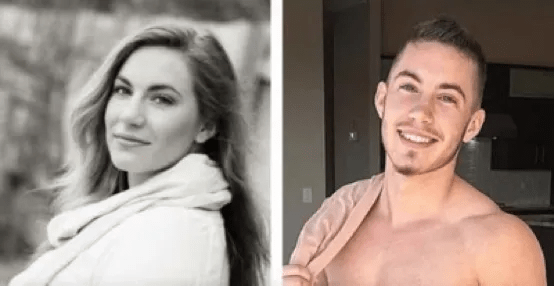
The two pictures above are both of transgender men (and relatively speaking, they do not ‘’overdo’’ it and have good looks, ordinary FTMs may not have such an appearance), and such a “muscular man” with body hair, beard, no women’s clothing, and low voice, before legally changing his gender, will have an ID card that shows he is a woman, which means that according to the requirements of TERFs and conservative women, he still has to go to the women’s toilet. So if ordinary women want to stipulate that “you go to the toilet according to the gender on your ID card”, it is impossible to achieve the goal of “no muscular men in the women’s toilet”.
In fact, whether it is to support going to the toilet matching with the gender on the ID card or to go the one matching with your gender identity, the results of both will lead to cisgender women encountering “muscular men”, either FTM who look like men, or MTFs who don’t look like women enough, or other people with a very masculine gender expression.
Now in China, those who are often blocked from going to the women’s toilet are not MTFs, not the “fake women without uteruses” or “males who fantasize about obtaining women’s privileges” that TERFs often ridicule, but FTMs and women with relatively neutral gender expression, who have uteruses and are defined by TERFs as “real women”. It’s an ironic paradox that the first people to be harmed by those values are the FTMs who they themselves consider to be women.
However, MTFs who are more like females cannot be stopped at all. As mentioned before, some FTMs may overdo their masculinity to conform to stereotype, resulting in being more masculine than ordinary males. The same is true for MTFs. They may also try to be “more female than females”, especially in the social atmosphere of East Asia. Usually, only MTFs who feel that they have become “feminine” enough will go to the women’s restroom, and such MTFs may not be distinguishiable from cisgender women in their appearance.
So the only way to satisfy TERFs’ demands might be to force-check IDs or genitalia. In the former case, ordinary people don’t have the power to check another person’s ID, which means that in the future every women’s restroom will have to have a police officer with authority on duty, or come with an ID scanning machine; in the latter case, it’s even more of an invasion of ordinary people’s right to privacy, whether it’s an inspector who goes through everyone’s genitals or some kind of verification machine …… All of these are quite absurd, difficult to realize, and highly invasive of privacy.
If the price of banning MTFs from the women’s restroom is that all cis women are forced to have their genitals or IDs checked, is this something that is done to ensure the rights of cis women?
But still, even if you went down this crazy way, there would be no way to stop “muscular men” from showing up in women’s restrooms. As mentioned above, an FTM’s ID may be female, and his genitals may very well still be categorized as female by existing biological categorization (there have been several cases of FTMs giving birth in the news), but their appearance is absolutely “manly”.
The starting point of the discussion mentioned above is that transgender people have to go to the toilet anyway, and we should never forget this.

So what to do? Well, there are solutions.
If cisgender people really want to have their demand of “not seeing muscular men in the women’s restroom” met no matter what, there are at least two solutions.
One is gender-neutral restrooms, or changing all existing restrooms into independent single rooms, just like some restrooms on airplanes and high-speed trains, all of which are set up as closed and independent single rooms, so that there is always only one person in it. This kind of single room is also very safe in addition to being private, because if hooligans could still take photographs and wait for the opportunity to sexually assault people in the women’s toilets in the past, then in the future when there are no more women’s toilets, and hooligans do something illegal again, a few muscular men may emerge to beat the person to a pulp.
Or a conciliatory, more moderate approach, is to build a gender-neutral restroom in addition to the already existing men’s and women’s restrooms, which is also acceptable.
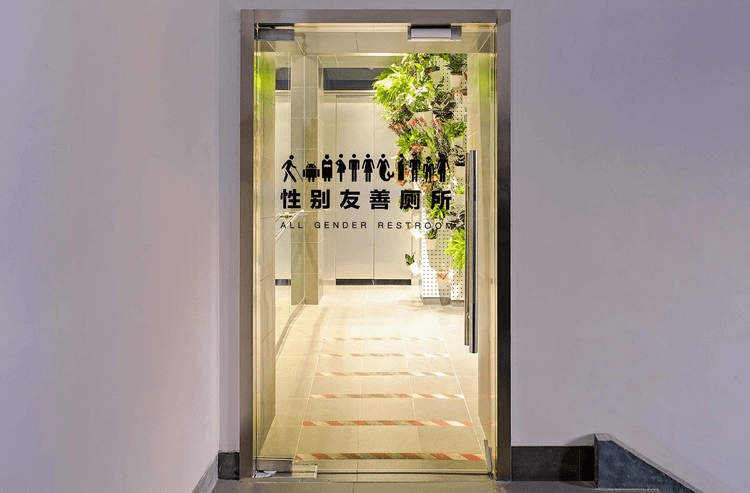
But this is an additional financial expense after all, and some people may say that you shouldn’t spend money on such things.
Then take a step back, gender-neutral accessible toilets are also OK.
Transgender people can still use existing gender-neutral accessible toilets, and most accessible toilets are gender-neutral.
I just hope that accessible toilets will not be built in existing men’s and women’s toilets. I have been to them in some shopping malls before. They are completely independent of existing toilets and do not distinguish between men and women, so they are gender-neutral, that is, no matter what kind of transgender people can use them. Considering that the transgender population is less than 1%, even if transgender people use them freely, it should not cause too much waste of efficiency and will not occupy public resources for other people in need.
It’s just that some accessible toilets will be built in existing toilets, so that brings us back to the starting point of the problem.
As long as transgender people are not blocked from using accessible toilets, then at least transgender people have a toileting plan.
Generally speaking, cisgender people will consider themselves as the starting point and say “I don’t want the ‘opposite sex’ to enter my toilet.”
What I have written above basically explains things neutrally with logic that cisgender people can accept, so I will mention some transgender perspectives below.
So for transgender people, what is the experience of transgender people every time they go to the bathroom?
Transgender women are forced to be placed in the men’s bathroom, facing either unintentional scrutiny or bad insults. In developed areas it may be okay, but in backward areas, they may be met with malicious verbal abuse and violence more frequently.
And trans men are just as likely to face scrutiny, vigilant scrutiny, avoidance of scrutiny, and to be treated like hooligans and denied access to restrooms by others (even showing a woman’s ID doesn’t help).
Therefore, many transgender people will carefully avoid the crowd to go to the bathroom, hoping to go when there is no one else in the bathroom. They are submissive and going to the bathroom is like going to war, whether it is sneaking to avoid enemy searches or facing a fierce confrontation on the battlefield.
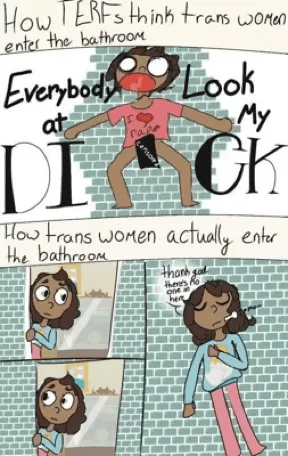
And what is the reason for the pain and mutual harm that this causes?
Some badly behaved trans person commits an atrocity in prison, and then this example keeps getting repeated by cisgender people. But just as most cisgender people aren’t criminals at all, most transgender people aren’t criminals, and if you wouldn’t assume that all males are potential rapists because of one case of rape, and if you wouldn’t assume that one female teacher physically punishing a student equates to all females being violent, then why can’t you wrap your head around it in the case of trans people?
I can say unequivocally that the average trans person goes to the bathroom just to go to the bathroom, and trans people have no interest whatsoever in being sexually aggressive.
Not to mention that many trans women are on estrogen and anti-testosterone drugs, and being in such a biological situation means one no longer has the objective capacity for forcing intercourse. Even on a psychological level, people will often adhere to female stereotypes if they think of themselves as women, meaning that they will try not to carry out bad stereotypical male traits, they don’t want to think of themselves as “stinky men” (no offense to males, not all men, just some of the bad ones), and they will be more attuned to feminine stereotypes. Some transgender people who consciously try to be gender neutral and break stereotypes have learned about gender equality and feminism, and have moral and civil principles. So where does the sexual assault allegation come from?
Some people always say that even if transgender people themselves don’t commit sexual assault, the trend will lead others to pretend to be transgender or claim to be transgender to commit sexual assault. But the question is, what does this have to do with transgender people? Transgender people’s demands have never been to encourage others to commit sexual assault.
Transgender people just want to go to the bathroom.
As mentioned above, transgender people have to go to the bathroom anyway.
If someone pretends to be a transgender person to commit sexual assault, why should this person’s evil deeds be attributed to the transgender community? Why should we sacrifice the rights of transgender people to live a normal life to pay for the atrocities of others? Aren’t sexual assaulters the ones who should be condemned? Is the blame shifted to transgender people just because transgender people are a minority, not part of the mainstream of society, have a low voice, and are easy to bully?

In the last paragraph, I want to talk about what kind of group transgender people are.
In my opinion the trans community is pretty similar to the disability community (it may be somewhat offensive, but that’s basically what I think).
Incongruence between your gender identity and body is like missing a pair of legs, and we’re just trying to get them attached and run around in the sunshine like everyone else.
Others may say to relax, that gender is not a shackle, that their pain is fantastical and non-existent, but the legs are still gone and the person can’t run.
Would an ordinary person look at a disabled person who has lost their legs and say that by using their mind to overcome the difficulties, the leg will grow back?
They won’t, will they? Ordinary people who see a disabled person who has lost their legs will suggest that they use machinery to build prosthetic legs and use all sorts of modern technology to assist them to live a normal life like everyone else. And HRT hormone treatment, and SRS sexual reassignment surgery, are the modern technologies that trans people have to reattach their legs.
For many transgender people, it’s not just the legs that are missing to run, we lack hands to express, eyes to see beauty, and a set of skin and bones to exist. We have a body, but it is as if no part of this body belongs to us, it feels like a computer with a virus that keeps sending out error alerts and pop-ups, looping and looping, lying in bed unable to rest, facing the mirror and seeing the abominable monster that hunts us day and night. People are inclined to avoid harm. When they see bad things, they can try their best to stay away from them. But if what we want to get away from, what we want to run away from, is our own bodies, then where do we go? Where do we rest?
Many transgender people, especially those who can’t afford the financial costs of HRT and SRS, choose to cut off their own genitals and commit suicide to escape their own bodies in an extreme way.

……
A lot of people say that being transgender is just imaginary, a fantasy.
If it really is a fantasy, then why do trans people suffer? Why do so many trans people self-harm and commit suicide, and why do some trans women just cut off their genitals in a medically unsafe environment like their homes? Why take drugs? Why take sleeping pills? Isn’t it just a fantasy? Isn’t it enough to not think about it?
If it’s a fantasy, if it’s true that you can become another gender just by fantasizing about it, transgender people don’t have to deal with so many psychological problems, they don’t have to self-harm, they don’t have to kill themselves, they don’t have to spend a huge amount of money on surgeries, they don’t have to expend a huge amount of energy on calming down their hearts.
If trans people were to choose their own gender, many trans people would not choose to be trans at all, but would choose to align with their gender identity at birth and be a regular cisgender person. Trans identity never brings any privilege, and the pain that comes with gender anxiety is unbearable for the average person.
In a class comparison, trans people are far from being on the level of cisgender people, and some TERFs accuse trans women of wanting a female identity while having male privilege, yet trans women don’t get any privilege, but instead are often discriminated against in employment and unreasonably fired from companies. Both trans men and trans women can experience widespread bullying in school, isolation from peers, be treated coldly by teachers, and expulsion from or discouragement in school. Where is the privilege in all of this, the lack of understanding and support from family members, the estrangement of friends after they learn about your transgender identity?
Hormone treatments and sexual reassignment surgeries are not a privilege, they are just a way to bring the transgender body to the standard of a normal human being, back to the starting point that any cisgender person has naturally; building transgender toilets is not a privilege, it is a way back to the starting point that any cisgender person naturally has; letting transgender people perform on stage and be the protagonists of video games, movies, and TV shows is also not a privilege, it is a way back to the starting point of cisgender people.
Cisgender people often don’t perceive their privilege, and because of the pain caused by an intersection of oppressive structures (e.g., racism, sexism, and class differences) they feel like they’re at the bottom of the social ladder. But they ignore the fact that the public facilities were built for them from the beginning, the culture is centered on them, and the rules were constructed with them in mind. They ignore the inconvenient environment in which trans people struggle, a social climate that instinctively rejects and alienates trans people.
And we work hard to overcome all this, so that in the end, we are back to the standard starting point of ordinary people. We make so much effort and overcome so many difficulties, just so we can live like a normal person.
I’m sorry, but I don’t want to be an emperor.
That’s not my business.
I don’t want to rule or conquer anyone.
I should like to help everyone if possible.
Homosexual, heterosexual, transgender, cisgender.
We all want to help one another.
Human beings are like that.
We want to live by each other’s happiness, not by each other’s misery.
We don’t want to hate or despise one another.
In this world, there’s room for everyone and the good earth is rich and can provide for everyone.
The way of life can be free and beautiful.
The author adapted this from Charlie Chaplin’s “The Great Dictator Speech”.
end
Written by: Ling Ziqing
Lay-out & Editing:Pei & Hannibal

 See Ding, seeding